 Add to Chrome
 Add to Firefox
 Add to Edge
Do Image-Text Metrics Respect Semantic Invariances?
May 23, 2026
Reference-free image-to-text evaluators are now standard for scoring image-caption alignment, yet it is unclear whether they respect semantic invariances. We present an invariance probe on five popular evaluators (CLIPScore, PAC-S, UMIC, FLEUR, and a deterministic LLM judge) under semantics-preserving perturbations along three axes -- spatial (flips, context-preserving repositioning, light rotations), object (scale, category), and socio-linguistic framing (cultural/economic adjectives with neutral and length-matched controls). Across curated slices of three detection datasets and three caption evaluation suites, we find consistent non-semantic sensitivities, where benign spatial edits and simple phrasing changes shift scores by $\approx$6--9\% on average, and for systems separated by just 0.7\%, these shifts can cause ranking flips in up to $\sim$37\% of cases, particularly under spatial changes. A small human study also supports this finding and confirms that annotators generally judge perturbed pairs as equally correct, so these shifts reflect metric behavior rather than semantic change. We further propose invariance-calibrated scoring, a post-hoc adjustment that roughly halves median absolute sensitivity while retaining correlation with learned caption evaluators.

Robust Audio-Text Retrieval via Cross-Modal Attention and Hybrid Loss
Apr 25, 2026Audio-text retrieval enables semantic alignment between audio content and natural language queries, supporting applications in multimedia search, accessibility, and surveillance. However, current state-of-the-art approaches struggle with long, noisy, and weakly labeled audio due to their reliance on contrastive learning and large-batch training. We propose a novel multimodal retrieval framework that refines audio and text embeddings using a cross-modal embedding refinement module combining transformer-based projection, linear mapping, and bidirectional attention. To further improve robustness, we introduce a hybrid loss function blending cosine similarity, $\mathcal{L}_{1}$, and contrastive objectives, enabling stable training even under small-batch constraints. Our approach efficiently handles long-form and noisy audio (SNR 5 to 15) via silence-aware chunking and attention-based pooling. Experiments on benchmark datasets demonstrate improvements over prior methods.
Anthropogenic Regional Adaptation in Multimodal Vision-Language Model
Apr 13, 2026While the field of vision-language (VL) has achieved remarkable success in integrating visual and textual information across multiple languages and domains, there is still no dedicated framework for assessing human-centric alignment in vision-language systems. We offer two contributions to address this gap. First, we introduce Anthropogenic Regional Adaptation: a novel paradigm that aims to optimize model relevance to specific regional contexts while ensuring the retention of global generalization capabilities. Second, we present a simple, but effective adaptation method named Geographical-generalization-made-easy (GG-EZ), which utilizes regional data filtering and model merging. Through comprehensive experiments on 3 VL architectures: large vision-language models, text-to-image diffusion models, and vision-language embedding models, and a case study in Southeast Asia (SEA) regional adaptation, we demonstrate the importance of Anthropogenic Regional Adaptation and the effectiveness of GG-EZ, showing 5-15% gains in cultural relevance metrics across SEA while maintaining over 98% of global performance and even occasionally surpassing it. Our findings establish Anthropogenic Regional Alignment as a foundational paradigm towards applicability of multimodal vision-language models in diverse regions and demonstrate a simple-yet-effective baseline method that optimizes regional value alignment while preserving global generalization.
Judging What We Cannot Solve: A Consequence-Based Approach for Oracle-Free Evaluation of Research-Level Math
Feb 06, 2026Recent progress in reasoning models suggests that generating plausible attempts for research-level mathematics may be within reach, but verification remains a bottleneck, consuming scarce expert time. We hypothesize that a meaningful solution should contain enough method-level information that, when applied to a neighborhood of related questions, it should yield better downstream performance than incorrect solutions. Building on this idea, we propose \textbf{Consequence-Based Utility}, an oracle-free evaluator that scores each candidate by testing its value as an in-context exemplar in solving related yet verifiable questions. Our approach is evaluated on an original set of research-level math problems, each paired with one expert-written solution and nine LLM-generated solutions. Notably, Consequence-Based Utility consistently outperforms reward models, generative reward models, and LLM judges on ranking quality. Specifically, for GPT-OSS-120B, it improves Acc@1 from 67.2 to 76.3 and AUC from 71.4 to 79.6, with similarly large AUC gains on GPT-OSS-20B (69.0 to 79.2). Furthermore, compared to LLM-Judges, it also exhibits a larger solver-evaluator gap, maintaining a stronger correct-wrong separation even on instances where the underlying solver often fails to solve.
CommonLID: Re-evaluating State-of-the-Art Language Identification Performance on Web Data
Jan 25, 2026Language identification (LID) is a fundamental step in curating multilingual corpora. However, LID models still perform poorly for many languages, especially on the noisy and heterogeneous web data often used to train multilingual language models. In this paper, we introduce CommonLID, a community-driven, human-annotated LID benchmark for the web domain, covering 109 languages. Many of the included languages have been previously under-served, making CommonLID a key resource for developing more representative high-quality text corpora. We show CommonLID's value by using it, alongside five other common evaluation sets, to test eight popular LID models. We analyse our results to situate our contribution and to provide an overview of the state of the art. In particular, we highlight that existing evaluations overestimate LID accuracy for many languages in the web domain. We make CommonLID and the code used to create it available under an open, permissive license.
LLM-Guided Lifecycle-Aware Clustering of Multi-Turn Customer Support Conversations
Jan 07, 2026Clustering customer chat data is vital for cloud providers handling multi service queries. Traditional methods struggle with overlapping concerns and create broad, static clusters that degrade over time. Reclustering disrupts continuity, making issue tracking difficult. We propose an adaptive system that segments multi turn chats into service specific concerns and incrementally refines clusters as new issues arise. Cluster quality is tracked via DaviesBouldin Index and Silhouette Scores, with LLM based splitting applied only to degraded clusters. Our method improves Silhouette Scores by over 100\% and reduces DBI by 65.6\% compared to baselines, enabling scalable, real time analytics without full reclustering.
FlexDoc: Parameterized Sampling for Diverse Multilingual Synthetic Documents for Training Document Understanding Models
Oct 02, 2025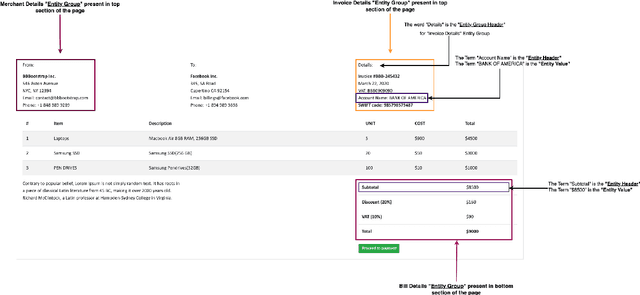
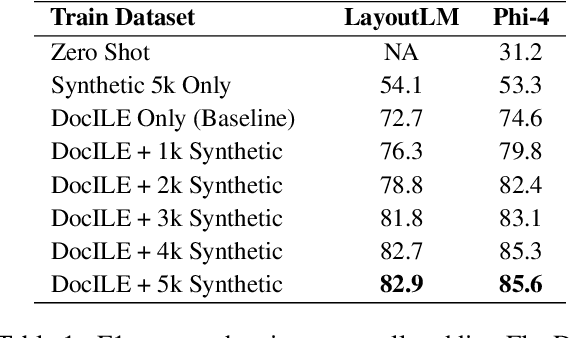
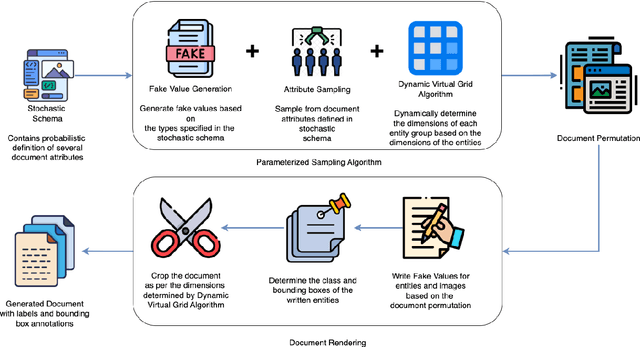
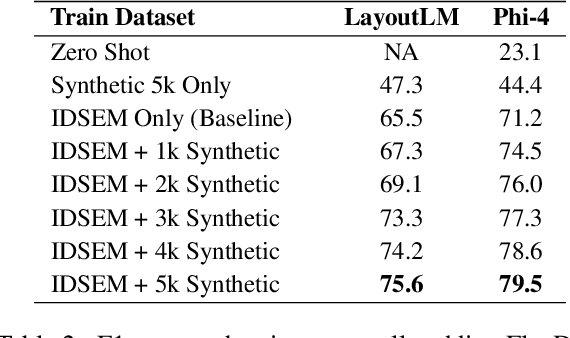
Developing document understanding models at enterprise scale requires large, diverse, and well-annotated datasets spanning a wide range of document types. However, collecting such data is prohibitively expensive due to privacy constraints, legal restrictions, and the sheer volume of manual annotation needed - costs that can scale into millions of dollars. We introduce FlexDoc, a scalable synthetic data generation framework that combines Stochastic Schemas and Parameterized Sampling to produce realistic, multilingual semi-structured documents with rich annotations. By probabilistically modeling layout patterns, visual structure, and content variability, FlexDoc enables the controlled generation of diverse document variants at scale. Experiments on Key Information Extraction (KIE) tasks demonstrate that FlexDoc-generated data improves the absolute F1 Score by up to 11% when used to augment real datasets, while reducing annotation effort by over 90% compared to traditional hard-template methods. The solution is in active deployment, where it has accelerated the development of enterprise-grade document understanding models while significantly reducing data acquisition and annotation costs.
Hard Negative Mining for Domain-Specific Retrieval in Enterprise Systems
May 23, 2025Enterprise search systems often struggle to retrieve accurate, domain-specific information due to semantic mismatches and overlapping terminologies. These issues can degrade the performance of downstream applications such as knowledge management, customer support, and retrieval-augmented generation agents. To address this challenge, we propose a scalable hard-negative mining framework tailored specifically for domain-specific enterprise data. Our approach dynamically selects semantically challenging but contextually irrelevant documents to enhance deployed re-ranking models. Our method integrates diverse embedding models, performs dimensionality reduction, and uniquely selects hard negatives, ensuring computational efficiency and semantic precision. Evaluation on our proprietary enterprise corpus (cloud services domain) demonstrates substantial improvements of 15\% in MRR@3 and 19\% in MRR@10 compared to state-of-the-art baselines and other negative sampling techniques. Further validation on public domain-specific datasets (FiQA, Climate Fever, TechQA) confirms our method's generalizability and readiness for real-world applications.
SweEval: Do LLMs Really Swear? A Safety Benchmark for Testing Limits for Enterprise Use
May 22, 2025Enterprise customers are increasingly adopting Large Language Models (LLMs) for critical communication tasks, such as drafting emails, crafting sales pitches, and composing casual messages. Deploying such models across different regions requires them to understand diverse cultural and linguistic contexts and generate safe and respectful responses. For enterprise applications, it is crucial to mitigate reputational risks, maintain trust, and ensure compliance by effectively identifying and handling unsafe or offensive language. To address this, we introduce SweEval, a benchmark simulating real-world scenarios with variations in tone (positive or negative) and context (formal or informal). The prompts explicitly instruct the model to include specific swear words while completing the task. This benchmark evaluates whether LLMs comply with or resist such inappropriate instructions and assesses their alignment with ethical frameworks, cultural nuances, and language comprehension capabilities. In order to advance research in building ethically aligned AI systems for enterprise use and beyond, we release the dataset and code: https://github.com/amitbcp/multilingual_profanity.
FS-DAG: Few Shot Domain Adapting Graph Networks for Visually Rich Document Understanding
May 22, 2025In this work, we propose Few Shot Domain Adapting Graph (FS-DAG), a scalable and efficient model architecture for visually rich document understanding (VRDU) in few-shot settings. FS-DAG leverages domain-specific and language/vision specific backbones within a modular framework to adapt to diverse document types with minimal data. The model is robust to practical challenges such as handling OCR errors, misspellings, and domain shifts, which are critical in real-world deployments. FS-DAG is highly performant with less than 90M parameters, making it well-suited for complex real-world applications for Information Extraction (IE) tasks where computational resources are limited. We demonstrate FS-DAG's capability through extensive experiments for information extraction task, showing significant improvements in convergence speed and performance compared to state-of-the-art methods. Additionally, this work highlights the ongoing progress in developing smaller, more efficient models that do not compromise on performance. Code : https://github.com/oracle-samples/fs-dag